
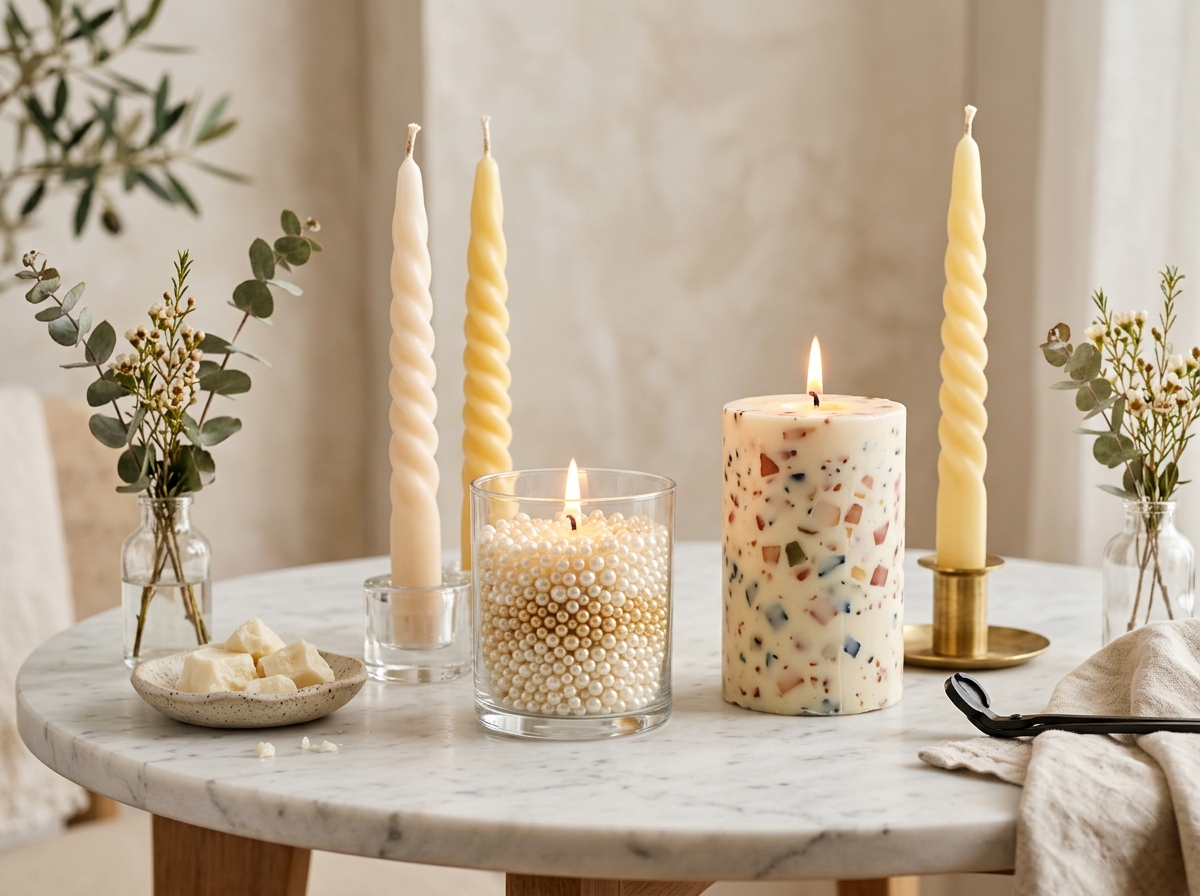
Candle making is often romanticized as simply melting wax, stirring in a splash of fragrance, and pouring it into a charming glass jar. But ask any aspiring candle maker who has watched their creation burn into a hollow tunnel, crack across the surface, develop white icy frosting, or emit zero scent when lit—and they will tell you the truth: candle crafting is pure thermal chemistry.
The 3 Immutable Laws of Professional Candle Performance
Every commercial candle brand that commands ₹599 to ₹1,299 per jar succeeds because of three foundational pillars: (1) Wax-Wick Synergy (creating a complete melt pool in under 3 hours without soot), (2) Fragrance Polymer Bonding (binding aroma compounds to wax esters at the precise flashpoint), and (3) Controlled Thermal Cure (allowing lipid crystallization to lock in aroma before lighting).
Whether you are pouring your very first batch of home candles or scaling an artisan fragrance business from your kitchen studio, this master guide delivers the exact formulation science, temperature milestones, wicking matrices, and troubleshooting playbooks used by certified master chandlers.
1. The Chemistry of Wax: Choosing the Right Foundation
Wax is not merely fuel; it is the delivery vehicle for fragrance and light. Different natural and synthetic waxes behave differently when heated, cooled, and burned. Using the wrong wax for a specific vessel or mold is the single most common cause of cracked tops, broken wicks, and poor fragrance release.
| Wax Type | Melt Point | Optimal Pour Temp | Max Fragrance Load | Primary Application |
|---|---|---|---|---|
| Golden Soy Wax (464 / 444) | 45°C – 49°C | 55°C – 60°C | 8% – 10% | Luxury eco container jars & amber glass vessels |
| Coconut-Soy Luxury Blend | 48°C – 52°C | 65°C – 70°C | 10% – 12% | Boutique scented jars with ultra-smooth porcelain tops |
| Pure Yellow / White Beeswax | 62°C – 65°C | 70°C – 75°C | 4% – 6% | Freestanding tapers, votives & natural air purifying pillars |
| Parasoy (Paraffin + Soy) | 52°C – 58°C | 68°C – 72°C | 10% – 12% | Commercial high-throw jar candles with zero frosting |
| Hard Pillar & Terrazzo Wax | 60°C – 68°C | 75°C – 80°C | 6% – 8% | Sculptural pillar candles, wax chunk melts & dessert bases |
Pro Artisan Tip: If pouring container candles in India’s warmer climates, pure Soy 464 can sometimes sweat or soften during shipping. Blending 80% Soy 464 with 20% Beeswax or Coconut wax increases thermal stability, prevents transit melt, and significantly enhances both cold and hot scent throw.
2. Scent Throw Science: Cold Throw vs. Hot Throw
Have you ever bought a handcrafted candle that smelled intoxicatingly rich on the counter, but produced virtually zero fragrance once lit? In the candle industry, this disparity is known as the difference between Cold Throw (scent dispersion when unlit) and Hot Throw (scent vaporization through the liquid wax pool).
The Golden Fragrance Load Formula
Many beginners measure fragrance in drops, teaspoons, or millitres. Candle chemistry must always be measured by weight in grams, because fragrance oils vary widely in specific gravity and density.
To calculate the exact amount of fragrance oil required for any batch, use the standard commercial formulation formula:
Fragrance Oil Weight (grams) = Wax Weight (grams) × (Fragrance Percentage ÷ 100)
Example: For a 200g jar of Golden Soy Wax at an 8% fragrance load:
200g × 0.08 = 16 grams of pure fragrance oil.
The 3 Non-Negotiable Scent Bonding Rules:
- Add Fragrance at Exactly 80°C – 85°C (176°F – 185°F): Adding fragrance oil to wax that is too cool prevents the aroma compounds from dissolving uniformly into the molten lipid chains. Adding it too hot flashes off the delicate top volatile citrus and floral notes. 82°C is the universal sweet spot for natural wax.
- Stir Slowly and Continuously for Exactly 2 Minutes: Do not rush this step. Stir gently in a figure-eight pattern. Rapid whisking incorporates micro air bubbles that cause sinkholes; insufficient stirring causes the fragrance oil to settle to the bottom of the jar, creating an uneven burn and a fire hazard.
- The 10–14 Day Soy Cure Rule: Natural plant-based waxes undergo polymorphic crystallization over 2 weeks. As the wax slowly forms crystalline lattice structures, it traps fragrance droplets in micro-pockets. Lighting a soy candle within 48 hours results in a 60% weaker hot throw compared to a candle cured for a full 14 days.
3. The Wicking Matrix: Sizing by Jar Diameter
The wick is the engine of the candle. It acts as an absorbent fuel pipe, drawing molten liquid wax upward through capillary action into the flame where it is converted into hot vapor. If the wick is too small, the flame cannot generate enough heat to melt across the jar diameter (causing tunneling). If the wick is too large, the flame flares, throws black carbon soot, and overheats the glass vessel.
| Jar Inner Diameter | Cotton Wick (ECO / CD Series) | Wooden Wick Recommendation | Melt Pool Benchmark |
|---|---|---|---|
| 45mm – 55mm (Sample Tins, Votives) | ECO 2 or CD 4 | 0.02" Single Ply (10mm width) | Full pool in 1.5 – 2 hours |
| 65mm – 75mm (Standard 150g – 200g Jars) | ECO 6 / ECO 8 or CD 8 / CD 10 | 0.03" Single Ply or Cross Wick (13mm width) | Full pool in 2 – 2.5 hours |
| 75mm – 85mm (Large 250g – 350g Jars) | ECO 12 or CD 14 | 0.04" Booster Wick (15mm width) | Full pool in 3 hours |
| 90mm+ (Wide 3-Wick Bowls) | Double or Triple ECO 4 spaced 35mm apart | Dual 0.03" Wooden Wicks | Even collective pool across surface |
The 1/4 Inch Trim Rule: Always instruct customers to trim their candle wicks to 1/4 inch (6mm) prior to every single burn. An untrimmed long wick generates excess carbon, flaring flames, and unsightly black soot rings on the container rim.
4. Master Troubleshooting Playbook: 6 Common Defects Solved
Every professional chandler has encountered flaws in their studio. Here is how to diagnose and permanently resolve the six most common candle making problems:
Defect 1: Tunneling (Wax Ring Left on Jar Walls)
The Symptom: The candle flame burns down a deep narrow cylinder in the center, leaving a thick wall of unburnt wax around the perimeter of the jar.
The Root Cause: The wick selected is too small (under-wicked) for the container’s diameter, or the candle was extinguished on its first burn before the liquid melt pool reached the glass edges.
The Fix: Step up one size in your wick series (e.g., from ECO 6 to ECO 8). Educate customers about the crucial “First Burn Rule”—always burn a new candle until the liquid wax pool reaches the glass rim (usually 2 to 3 hours).
Defect 2: Deep Sinkholes & Cavities Around the Wick
The Symptom: As the candle cools, a deep hole or crater forms around the wick base, often hiding hollow air pockets underneath.
The Root Cause: The wax was poured at too high a temperature, causing the outer edges against the cold glass to solidify much faster than the molten core around the wick.
The Fix: Lower your pour temperature to 55°C – 58°C for soy wax. Pour in a room maintained at 22°C–25°C. If a sinkhole appears, gently smooth the surface with a craft heat gun on low speed, or perform a second micro-pour (top-up) with 10% reserved wax.
Defect 3: Frosting & White Crystalline Bloom
The Symptom: A white, crystal-like frost forms across the surface or sides of natural soy candles.
The Root Cause: Frosting is a natural polymorphic recrystallization unique to pure vegetable waxes. While it proves the wax is 100% natural, commercial customers sometimes mistake it for an imperfection.
The Fix: Pre-warm your glass jars to 40°C before pouring to slow down edge cooling. Allow candles to cool slowly on a wire baker’s rack away from air conditioner drafts or ceiling fans. Alternatively, blend 15% to 20% Coconut wax into your soy formula to create satin-smooth tops.
Defect 4: Wet Spots (Glass Adhesion Pull-Away)
The Symptom: Patches of the candle look dark or “wet” against clear glass containers.
The Root Cause: Wax shrinks naturally as it solidifies. In areas where the glass cooled faster, the wax shrinks away from the glass surface, creating an optical illusion of liquid trapped between the wax and vessel.
The Fix: Thoroughly wash glass vessels with isopropyl alcohol to remove dust and machine oils before wicking. Pre-warm jars slightly before pouring, and switch to frosted or amber glass vessels where microscopic adhesion variance remains invisible.
Defect 5: Mushrooming & Carbon Soot Balls
The Symptom: A carbon buildup resembling a black mushroom forms at the tip of the wick, causing crackling, flaring, and soot.
The Root Cause: The candle is burning more fuel (wax and fragrance) than the flame can completely consume. This occurs when the wick is oversized or when fragrance oil load exceeds 10%.
The Fix: Reduce your fragrance load by 1–2% and drop down one wick size. Always trim the wick before re-lighting.
Defect 6: Zero Hot Throw (No Scent in the Room)
The Symptom: The candle smells delightful in the tin, but produces zero aroma when burning in a bedroom or living area.
The Root Cause: Fragrance oil was added at too low a temperature (<70°C) and failed to bind; the candle was burned before curing; or the wick is too small to reach the 60°C+ pool temperature required to volatilize heavy base notes.
The Fix: Ensure fragrance is mixed at 82°C for 2 full minutes. Enforce a strict 10-day curing period. Check that the melt pool reaches 1/4 inch depth across the entire diameter of the jar within 2.5 hours.
5. Commercial Blueprint: Costing & Profit Margins in India
Handcrafted scented candles carry some of the healthiest gross profit margins in the modern Indian lifestyle sector. Here is a realistic commercial costing breakdown for a luxury 200g Amber Glass Scented Soy Candle produced from a home studio:
| Raw Material Component | Bulk Purchase Specification | Quantity per 200g Candle | Unit Cost (₹) |
|---|---|---|---|
| Golden Soy Wax (Grade 464) | ₹180 – ₹220 per kg | 184 grams | ₹36.80 |
| IFRA-Certified Fragrance Oil | ₹2,200 – ₹2,800 per kg | 16 grams (8% load) | ₹38.40 |
| Cotton Wick with Metal Sustainer | ₹350 per pack of 100 wicks | 1 piece | ₹3.50 |
| 250ml Heavy Amber Glass Jar | ₹38 – ₹46 per piece with tin/bamboo lid | 1 jar + lid | ₹42.00 |
| Foil-Stamped Waterproof Label | ₹4 – ₹7 per sheet / digital cut | Front + Base warning label | ₹6.00 |
| Rigid Kraft Gift Box & Paper Padding | ₹22 – ₹28 in batch wholesale | 1 presentation box | ₹24.00 |
| Total Direct Production Cost | All Materials Included | 1 Completed Luxury Unit | ₹150.70 |
A beautifully formulated, luxury-scented 200g amber candle with clean branding retails comfortably in India between ₹549 and ₹899 on Shopify, Instagram, and premium lifestyle pop-ups.
At an average selling price of ₹649, each candle generates ₹498.30 in gross profit per unit (76.8% Gross Margin). Producing and fulfilling just 100 candles a month generates nearly ₹50,000 in monthly net income from a compact home workspace.
Ready to Master the Art & Business of Candle Making?
Transform your passion into a certified artisanal business. Join Alphaaa Academy’s comprehensive live interactive masterclasses covering Basic Container Jars, Spiral Tapers & Terrazzo Pillars, Relaxing Aromatherapy Massage Candles, Gourmet Dessert Candles, and Luxury French Vessel Styling.
✨ Live Interactive Training • Complete Formulation Guide (PDF) • Verified Wholesale Vendor Contacts • Official Artisan Diploma
Master This Craft with Step-by-Step Live Mentorship
Get interactive video masterclasses, downloadable formulation recipes, direct raw-material vendor directories, and certificate of completion.
Explore All Academy Workshops →