
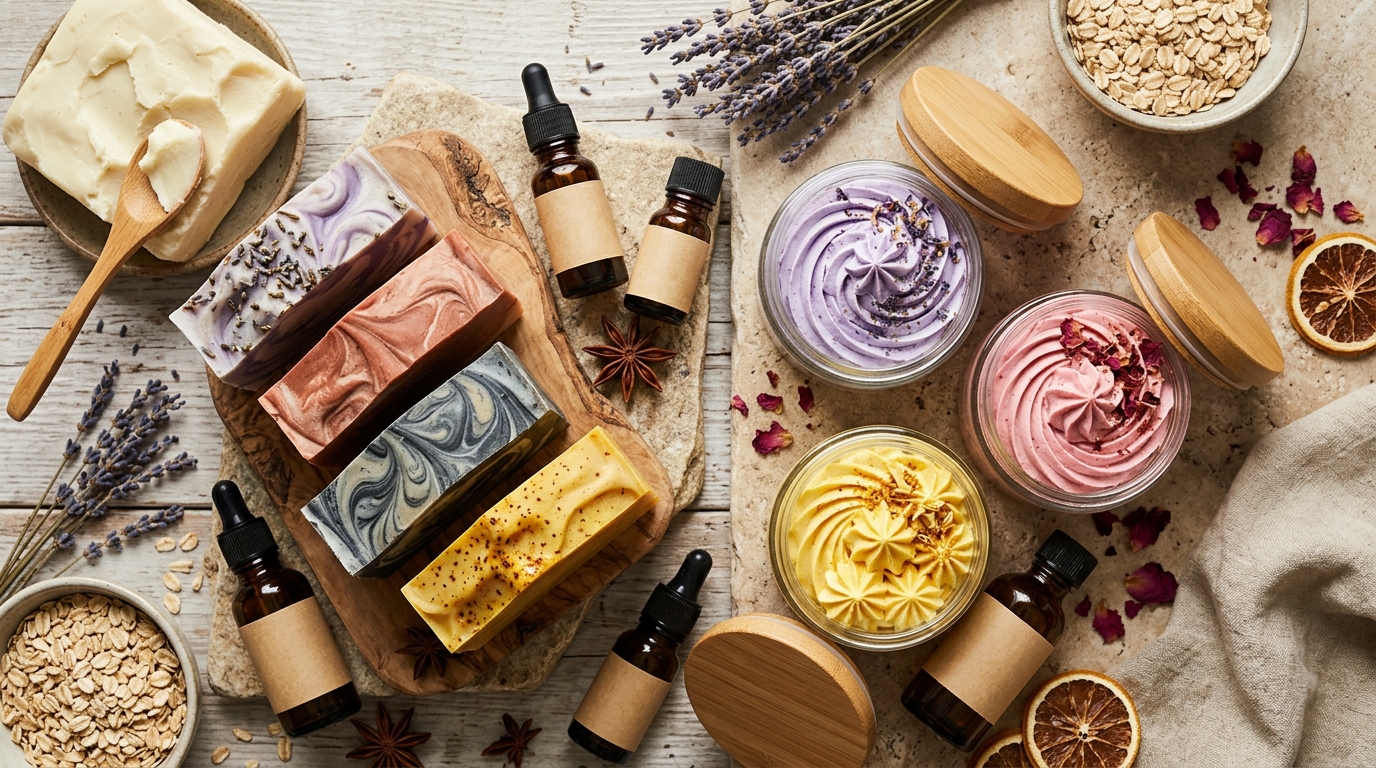
In an era where consumers are scrutinizing ingredient lists and rejecting mass-produced commercial detergent bars filled with harsh synthetic sulfates, the demand for handcrafted artisan soap has skyrocketed across India. From creamy cold-process olive oil bars and gemstone melt-and-pour swirl bars to decadent cloud-soft whipped soap scrubs, artisan soap making represents one of the most rewarding, creative, and profitable home-based skincare businesses you can start today.
The Indian Artisan Soap Market Opportunity
A single luxury artisan soap bar costs between ₹35 and ₹50 to produce using premium botanical oils, therapeutic clays, and pure essential oils. In the D2C retail and festive gifting market, that same bar commands between ₹249 and ₹449. Artisanal bath and body crafters enjoy healthy 75% to 85% gross profit margins, with repeat re-order rates higher than almost any other handmade craft discipline because soap is a consumable daily essential.
Whether you are a beginner looking to pour your very first fragrance bar or an experienced maker aiming to scale a full cosmetic line, this comprehensive master guide breaks down the three foundational soap making methods, chemistry fundamentals, costing formulas, and branding strategies.
The 3 Core Soap Making Methods Compared
Understanding which technique aligns with your startup budget, studio space, and artistic vision is step one:
| Method | Difficulty Level | Turnaround Time | Key Equipment | Best For |
|---|---|---|---|---|
| Melt & Pour (MP) | Beginner | 1 – 2 Hours | Microwave/double boiler, silicone molds | Quick creative designs, gemstone soaps, dessert cupcakes, zero lye handling |
| Cold Process (CP) | Intermediate / Pro | 4 – 6 Weeks Cure | Immersion blender, digital scale, safety goggles, lye pitcher | True artisanal saponification, 100% control over fatty acid profiles, organic certification |
| Whipped Soap Cream | Intermediate | Same Day | High-speed electric hand mixer, pastry piping bags | Fluffy foaming cleansing butters, exfoliating sugar scrubs, luxury jar packaging |
Method 1: Melt & Pour Soap Making (Quick, Vibrant & Safe)
Melt and Pour soap is pre-saponified soap base (such as Goat Milk, Shea Butter, Aloe Vera, or Ultra-Clear Glycerin base) that you gently liquefy, customize with botanical extracts and essential oils, and pour into molds.
Key Advantages:
- Zero Lye (Sodium Hydroxide) Handling: Safe for beginners, teenagers, and crafting in standard family kitchens.
- Instant Gratification: Hardens and is ready to unmold and use within 90 minutes.
- Stunning Visual Versatility: Crystal-clear bases allow embedding dried botanicals, realistic fruit soap segments (like watermelon rind and pulp), embedded toys, and intricate layered swirls.
Pro Maker Tips for Melt & Pour:
- Control Melting Temperature: Never overheat your base beyond 60°C (140°F). Boiling base burns off glycerin, causing rubbery lather and excessive shrinkage.
- Eliminate Surface Bubbles: Keep a fine-mist spray bottle filled with 99% Isopropyl Alcohol (IPA) handy. A quick spritz on freshly poured liquid instantly breaks surface tension and pops all micro-bubbles.
- Prevent Sweating (Glycerin Dew): In India’s humid monsoon climate, glycerin draws moisture from the air, creating tiny water beads on the surface. Use Low-Sweat Melt & Pour bases, work in air-conditioned environments, and shrink-wrap finished bars immediately once cooled.
Method 2: Cold Process Soap Making (The Gold Standard of Artisanal Soap)
Cold Process soap making is the authentic alchemical art of crafting soap from raw plant oils and lye (Sodium Hydroxide dissolved in distilled water). Through the exothermic reaction known as saponification, the triglycerides in oils and the hydroxide ions transform completely into pure sodium soap molecules and natural glycerin.
The Golden Rule of Lye Safety
Always pour LYE CRYSTALS INTO WATER—never pour water into lye! Pouring water onto dry lye can cause violent steam volcanos and caustic splashing. Always wear wrap-around safety goggles, heavy chemical-resistant nitrile gloves, and work in a well-ventilated space.
The Anatomy of a Balanced Oil Formula:
A great cold-process bar must balance hardness, cleansing power, creamy conditioning lather, and skin moisturization. Here is a battle-tested master formula for Indian crafters:
- 35% Pure Olive Oil / Rice Bran Oil: Provides gentle, deeply conditioning oleic acid for sensitive skin.
- 30% Pure Coconut Oil: Contributes lauric and myristic acids, generating quick, fluffy, rich bubbles and hardness.
- 25% Refined Palm Oil (or Cocoa/Kokum Butter): Delivers palmitic and stearic acids for a durable, long-lasting bar that doesn’t turn to mush in the shower.
- 10% Castor Oil: Contains ricinoleic acid, the ultimate natural lather booster and stabilizer that locks in rich foam.
Superfatting (Lye Discount): Formulate with a 5% to 7% superfat. This guarantees that 5% of your skin-loving oils remain unreacted as free conditioning oils in the final soap, ensuring a gentle, moisturizing wash.
The Curing Cycle:
Cold process soap must cure on drying racks with good airflow for 4 to 6 weeks. While saponification completes within 48 hours, curing evaporates excess water, hardening the soap crystalline structure so the bar lasts twice as long in customer showers.
Method 3: Whipped Soap Cream (The Modern Dessert Cleanser)
Whipped soap is a cloud-like, fluffy cleanser with the texture of rich buttercream frosting. Formulated from scratch using mild coconut-derived surfactants like Sodium Cocoyl Isethionate (SCI) powder, vegetable glycerin, and stearic acid, whipped soap doubles as a body cleanser, shaving cream, and foaming sugar scrub base.
Crafting Whipped Soap:
- Gently melt stearic acid and vegetable glycerin in a heatproof bowl.
- Incorporate SCI powder and mild liquid surfactants (like Coco Betaine).
- Using a high-speed electric mixer, whip the mixture for 10–15 minutes until it expands by 3x in volume, creating glossy, stiff peaks.
- Fold in nourishing carrier oils (Sweet Almond Oil or Argan Oil), skin-safe cosmetic micas (soft pink, lavender, mint), and IFRA-certified fragrance oils.
- Transfer the whipped cream into a piping bag fitted with a large 1M star pastry nozzle and pipe gorgeous two-tone swirls directly into wide-mouth cosmetic jars.
Commercial Costing Breakdown: 100g Artisan Soap Bar
Here is a real-world commercial batch production costing breakdown for a luxury 100g Cold Process Lavender & Kaolin Clay Bar:
| Raw Material / Expense | Batch Allocation (100g Bar) | Cost (INR) |
|---|---|---|
| Cold-Pressed Oils (Olive, Coconut, Palm, Castor) | 75g base oils | ₹18.50 |
| Food-Grade Sodium Hydroxide & Distilled Water | Saponification base | ₹2.20 |
| Pure French Lavender Essential Oil | 3g pure essential oil | ₹9.80 |
| White Kaolin Clay & Purple Brazilian Mineral Clay | Natural color & skin slip | ₹3.50 |
| Kraft Paper Cigar Band Box & Seal | Eco-friendly packaging | ₹4.50 |
| Studio Electricity & Overheads | Blending & curing space | ₹2.50 |
| Total Direct Production Cost | Finished 100g Artisan Bar | ₹41.00 |
| B2B Wholesale / Bulk Corporate Price | Minimum 25 units | ₹140.00 – ₹175.00 |
| Recommended Retail Selling Price (MRP) | D2C Website / Instagram Store | ₹299.00 – ₹399.00 |
| Estimated Net Profit Margin | Per Bar Sold Online | ₹258.00 – ₹358.00 (86% Margin) |
Packaging & Sweat-Proofing for the Indian Climate
- Breathable Packaging for Cold Process: Never seal cold process soap in airtight plastic. It needs to breathe. Use uncoated kraft paper belly bands, unbleached cotton pouches, or windowed cardboard boxes.
- Airtight Shrink Wrap for Melt & Pour: Because glycerin attracts moisture, wrap cured Melt & Pour bars tightly with biodegradable polyolefin shrink film using a heat gun.
- Cosmetic Jars with Pressure Seals for Whipped Soaps: Pack whipped soaps in PET or glass jars with foam liner seals to prevent moisture loss and keep the texture pillow-soft.
Regulatory & Legal Compliance in India
When starting from home, testing small batches for friends and local pop-up markets requires minimal red tape. As you scale to a commercial brand:
- Udyam MSME Registration: Free online government registration for small craft businesses in India.
- Cosmetics Compliance: In India, the manufacture and sale of cosmetics are governed by the Drugs and Cosmetics Act. If manufacturing cold process and skincare creams commercially at scale, work toward obtaining a state cosmetic manufacturing license or partner with an Ayush/GMP-certified third-party manufacturing unit.
- Mandatory Product Labeling: Clearly list batch number, manufacturing date, net weight, complete INCI ingredient breakdown, and manufacturer contact details.
Master Professional Soap Crafting with Live Mentorship!
Ready to formulate professional, skin-safe, salon-grade soaps with zero guesswork? Join Alphaaa Academy’s upcoming live interactive workshops with formula calculation sheets, supplier contacts, and official certification:
Join Complete Soap Masterclass Combo (₹1,846) →
Whipped Soap Workshop (₹499) →
Includes live batches across Melt & Pour, Advance Gourmet Melt & Pour, Cold Process, and Whipped Soap Cream with Indian wholesale vendor contacts.
Frequently Asked Questions (FAQ)
Can I make soap without sodium hydroxide (lye)?
Chemical soap cannot exist without lye—by scientific definition, soap is the salt of a fatty acid formed when lye reacts with oils. However, with Melt and Pour soap bases, the saponification reaction has already been performed in a factory under strict laboratory controls, allowing you to melt and design soaps safely without handling raw lye.
How long does handmade soap last?
A well-formulated, properly cured cold-process bar typically lasts 12 to 24 months. Storing soaps in a cool, dry place away from direct sunlight preserves fragrance vitality. In the shower, using a slatted draining soap dish allows the bar to dry between uses, extending its lifespan significantly.
Which oils create the most lather in cold process soap?
Coconut oil and castor oil are the champions of lather. Coconut oil creates big, fluffy, bubbly foam, while castor oil (even at just 5% to 10% of your total oil weight) acts as a surfactant stabilizer, turning thin bubbles into rich, dense, creamy lather.
Can I use food coloring or candle fragrance in soap?
No. Never use candle fragrance oils or food coloring. Food colors brown, fade, or morph unpredictably when exposed to the alkaline pH of raw soap batter. Always use cosmetic-grade, IFRA-certified body-safe fragrance oils and mineral micas or natural clays tested for high pH stability.
Master This Craft with Step-by-Step Live Mentorship
Get interactive video masterclasses, downloadable formulation recipes, direct raw-material vendor directories, and certificate of completion.
Explore All Academy Workshops →